Reporting from the United States
‘Gas-station heroin’ is driving the US into a new opioid crisis: “It will kill people”
In America’s latest opioid crisis, the drugs are not being prescribed by doctors. “Gas-station heroin” is sold over the counter next to condoms, hot dogs and scratch-off lottery tickets.
“It is just as addictive as heroin,” says physician Brian Harris, who warns that users may turn to fentanyl and heroin when the substance 7-OH is eventually banned.
By Carolina Lundin
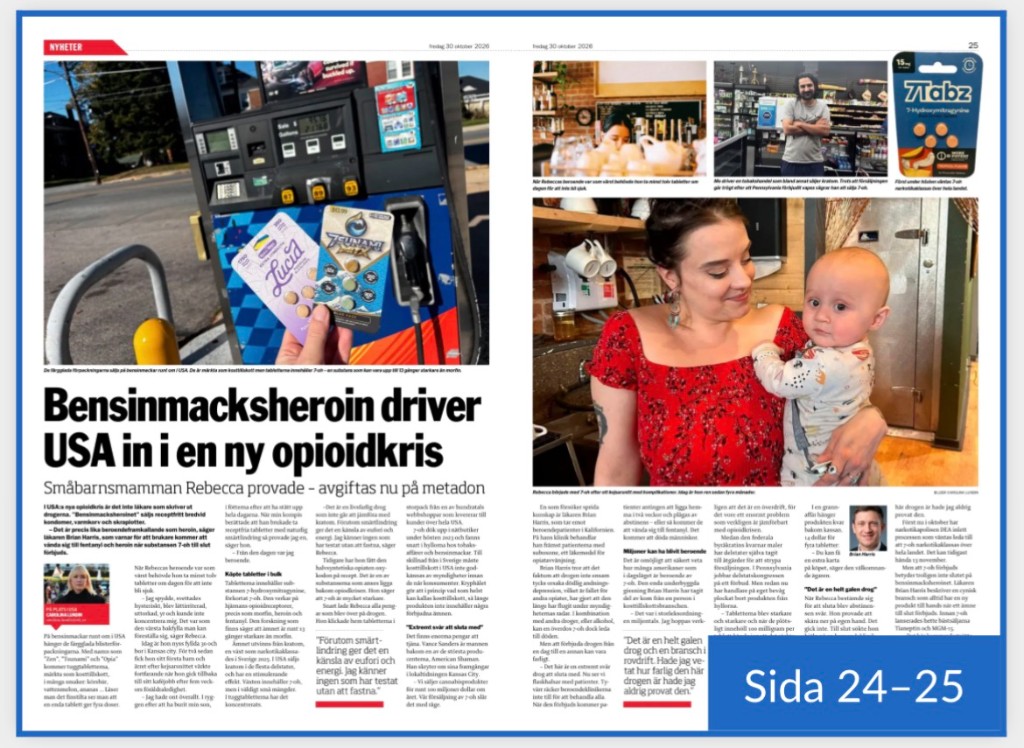
Colorful blister packs hang in gas stations across the United States. Sold under names such as “Zen,” “Tsunami” and “Opia,” the chewable tablets are labeled as dietary supplements and come in a range of flavors: cherry, watermelon, pineapple and more. Read the fine print and you will see that a single tablet contains four doses. At the height of Rebecca’s dependence, she needed to take at least twelve tablets a day to keep from getting sick.
“I was throwing up, sweating profusely, becoming irritable and dehydrated. I was dizzy and couldn’t concentrate. It was like the worst hangover you can imagine,” Rebecca says.
She has just turned 30 and lives in Kansas City. Two years ago, she had her first child, and the scar from her C-section was still painful when she returned to her job at a café after five weeks of maternity leave.
“I was in pain everywhere. My back hurt from carrying my son, and my feet hurt from standing all day. When a friend told me he used over-the-counter tablets for natural pain relief, I decided to try one,” she says.
“From that day on, I was addicted.”
Rebecca began taking 7-OH after complications from a C-section. She has now been in recovery for four months. Photo: Private/Jewel Fivecoat
Buying tablets in bulk
The tablets contain 7-hydroxymitragynine, commonly abbreviated as 7-OH. It acts on the brain’s opioid receptors, just like morphine, heroin and fentanyl. The available research suggests that the substance is around 13 times more potent than morphine.
The substance is derived from kratom, a plant that was classified as a narcotic in Sweden in 2025. In the United States, kratom is sold in most states and has a stimulant effect. The plant contains 7-OH, but only in very small amounts. In the chewable tablets, it has been concentrated.
“This is a deadly drug that cannot be compared with kratom. In addition to pain relief, it produces a feeling of euphoria and energy. I don’t know anyone who has tried it without getting hooked,” Rebecca says.
7-OH is frequently sold under names that evoke traditional opioids. Photo: Carolina Lundin
In the past, she had been prescribed the semi-synthetic opioid oxycodone. It is one of the substances considered to have contributed to the opioid crisis. She says 7-OH is much stronger. Soon, Rebecca was spending all the money she had left on the drug. She ordered the tablets in bulk from one of hundreds of online stores that ship to customers across the United States.
7-OH appeared in online stores in the fall of 2023 and soon began showing up on the shelves of tobacco shops and gas stations. Unlike in Sweden, dietary supplements in the United States do not have to be approved by government agencies before they reach consumers. This loophole means that almost anything can be marketed as a dietary supplement, as long as the product does not contain any prohibited substances.
“Extremely difficult to quit”
There is enormous money to be made. Vance Sanders is the man behind one of the largest producers, American Shaman. He has boasted about his success in the local newspaper in Kansas City.
“We sell around $100 million worth of cannabis products a year. Our 7-OH sales far exceed that.”
One person trying to raise awareness is physician Brian Harris, who treats patients with substance-use disorders in California. At his clinic, he primarily treats patients with Suboxone, a medication used in opioid addiction treatment.
Brian Harris launched the website www.7-oh.help to share information with both users and fellow medical professionals. Photo: Press image/wakesleep.net
Brian Harris believes that the fact that the drug does not appear to cause fatal respiratory depression on its own—as other opioids do—has kept it under regulators’ radar for a long time. However, an overdose involving 7-OH can be fatal when it is combined with other drugs or alcohol. But banning the drug overnight could be dangerous.
“This is an extremely difficult drug to quit. We are now seeing bottlenecks, with patients waiting for treatment. Unfortunately, addiction clinics do not have the capacity to treat everyone. When it is banned, patients will either spend two weeks at home suffering through withdrawal—or they will turn to fentanyl. That will kill people.”
Millions may have become dependent
It is impossible to know for certain how many Americans are currently dependent on 7-OH. The only informed estimate Brian Harris has come across came from someone in the dietary-supplement industry.
“The estimate was in the millions. I sincerely hope that is an exaggeration, because it would be an enormous problem—one truly comparable to the opioid crisis.”
While the federal bureaucracy moves slowly, individual states have taken action to curb sales. In Pennsylvania, the state legislature is working on a ban. But some retailers have already removed the product from their shelves on their own initiative.
Mo runs a tobacco shop that sells, among other things, kratom. Despite sluggish sales after Pennsylvania banned vapes, he refuses to sell 7-OH. Photo: Carolina Lundin
“The tablets kept getting stronger, and when they suddenly contained 100 milligrams per tablet, I felt that was enough. It can be downright dangerous,” says Mo, a shopkeeper in the small town of York.
What kind of customers were interested?
“All kinds. A lot of truck drivers, but also retirees looking for pain relief.”
In a neighboring store, the product is still on display behind the counter. Four tablets cost $14.
“You can have an extra blister pack for free,” the welcoming owner says.
“It’s a completely crazy drug”
When Rebecca decided to quit, the withdrawal symptoms were severe. She tried to taper off on her own, but it did not work. Eventually, she sought help at an addiction clinic where staff had never heard of the substance. For the past four months, she has been undergoing treatment with methadone, and the clinic has quickly seen an influx of more patients.
“It’s a completely crazy drug, and this is an industry run amok. If I had known how dangerous this drug was, I would never have tried it.”
Photo: Private/Jewel Fivecoat
Only now, in October, has the Drug Enforcement Administration (DEA) begun the process expected to lead to 7-OH being classified as a controlled substance nationwide. That could happen as early as November 13.
But a ban on 7-OH probably will not mean the end of “gas-station heroin.” Physician Brian Harris describes a cynical industry that always has a new product ready when one substance is finally banned. Before 7-OH was launched, the bestsellers were called Tianeptine and MGM-15.
“This will continue to be a game of cat and mouse. Producers read research papers intended for medical professionals and then develop drugs they know will be addictive. I think opposition to legislative change is too strong for that to be changed.”
Carolina Lundin