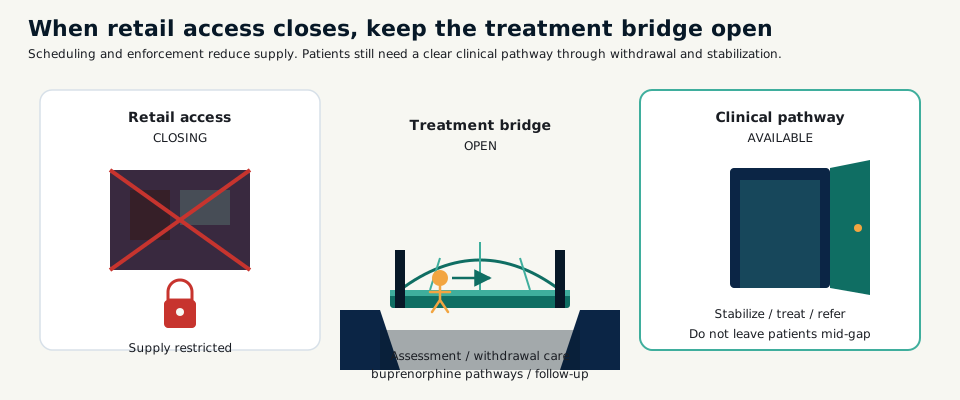
Governing principle
Treat the patient’s exposure, physiology, and clinical state. Commercial products may contain concentrated 7-OH, mitragynine pseudoindoxyl, MGM analogues, other alkaloids, or mislabeled quantities. Direct human PK for repeated high-dose purified 7-OH remains inadequately defined.
Pathway A — Standard buprenorphine initiation
Reasonable when product history is reasonably clear and the patient shows convincing, progressive opioid withdrawal. Use the clinician’s established protocol with reassessment after each step.
There is no evidence-based universal minimum interval after the last 7-OH dose. Rules such as “always safe after 12, 16, or 24 hours” are not supportable.
Pathway B — Low-dose buprenorphine initiation
Consider when last exposure is uncertain; q1–3h redosing with inability to tolerate abstinence; possible mixed exposure (mitragynine, MP, MGM, fentanyl); prior precipitated withdrawal; or high consequence of a withdrawal spike. Local protocols and monitoring capacity determine the schedule. Educational notes on microinduction / tapered crossover rationale are in downloads—not a public milligram ladder.
Pathway C — Methadone
Appropriate when buprenorphine is unsuitable or unsuccessful, preference or OTP structure fits, or high tolerance warrants it. Apply standard OUD safeguards (QTc, sedating co-medications, respiratory disease).
Pathway D — Symptomatic treatment without MOUD
May fit mild, brief exposure without compulsive use or high substitution risk. Usually a poor stand-alone strategy for frequent redosing, nocturnal withdrawal, or high likelihood of seeking another opioid.
Adjuncts and pitfalls
Familiar withdrawal adjuncts (alpha-2 agonists, antiemetics, antidiarrheals when appropriate, nonopioid analgesics, hydration, careful sleep support) can help. Avoid reflexively stacking sedatives. Do not start naltrexone while still physically dependent without an adequate opioid-free interval.
Prevent the predictable failure mode
Counsel that counterfeit pills and street opioids may contain fentanyl, and that trying to reproduce a familiar 7-OH effect is not dose-equivalent or safe. Supply naloxone. Plan follow-up and maintenance versus taper explicitly.
Clinician downloads
- Intake & induction protocol (PDF)
- Triage & risk screening
- Special populations & interactions
- Full longform treatment module
Printable assessment · Clinician hub · Withdrawal course · Patient guide · All downloads